
How Long Can a Breathalyzer Detect Alcohol? [Explained]
Author: LifeSafer Team
How long can a breathalyzer detect alcohol, really?
Consider this scenario. It’s 6:45 a.m., and you’re standing in your kitchen, keys in hand, running the math in your head:
“Two beers, stopped drinking around 10 last night, slept eight hours — I should be fine.”
That “should be fine” feeling might be a trap.
In reality, a breathalyzer can detect alcohol for 12 to 24 hours after your last drink, depending on things like how much you drank, your body size, and how quickly you metabolize alcohol.
So while one moderate drink may clear your system in about one to two hours, a heavier night of drinking can still be sitting in your blood and on your breath when your alarm goes off.
LifeSafer has spent more than three decades developing NHTSA-certified ignition interlock devices (IIDs), and we’ve learned that most people aren’t purposefully misjudging how long alcohol actually stays in their system. They simply don’t know how long alcohol can remain detectable.
So let’s find out exactly what affects that window and how breathalyzers detect alcohol before you get behind the wheel.
Key Takeaways
- Alcohol can be detectable for 12–24 hours after your last drink — a single moderate drink may clear in 1–2 hours, but a heavier night can still register the next morning.
- Your liver clears alcohol at a fixed rate (about 0.015% BrAC per hour), regardless of coffee, cold showers, or water — only time actually lowers your BrAC.
- Detection time depends on several personal factors, including how much you drank, body weight, biological sex, metabolism, and drink strength.
- “Last night” can still count in the morning — someone who stops drinking at midnight around 0.15% BrAC may not hit 0.00% until close to 10 a.m. depending on their personal factors
The Short Answer: Breathalyzer Detection Windows at a Glance
Your liver processes alcohol at about 0.015% breath alcohol concentration (BrAC) per hour. It doesn’t care that you have a 7 a.m. call, and it doesn’t speed up after drinking an espresso. It’s the one part of this whole situation that isn’t negotiable, making planning a lot easier.
Here’s what that pace looks like:
BrAC Level | Roughly Equivalent To | Time to 0.00% |
Low: 0.02–0.05% | 1–2 standard drinks | 2–4 hours |
Moderate: 0.08% | 3–4 standard drinks (legal limit) | 5–6 hours |
High: 0.15%+ | 6 or more drinks | 10+ hours |
A “standard drink,” for what it’s worth, is a 12-oz beer, a 5-oz pour of wine, or a 1.5-oz shot — not the generous pour a bartender gives you on a Friday, and definitely not a 9% double-dry-hopped IPA.
If your night involved anything stronger or bigger than that, push your estimate later.
How Does a Breathalyzer Detect Alcohol on Your Breath?
Alcohol is one of the only things you consume that skips digestion entirely. When you drink, it goes straight from your stomach into your bloodstream, and as blood passes through your lungs, some alcohol moves into the air in your lungs. Breathe out, and a measurable, reliable sample of your blood alcohol comes with it.
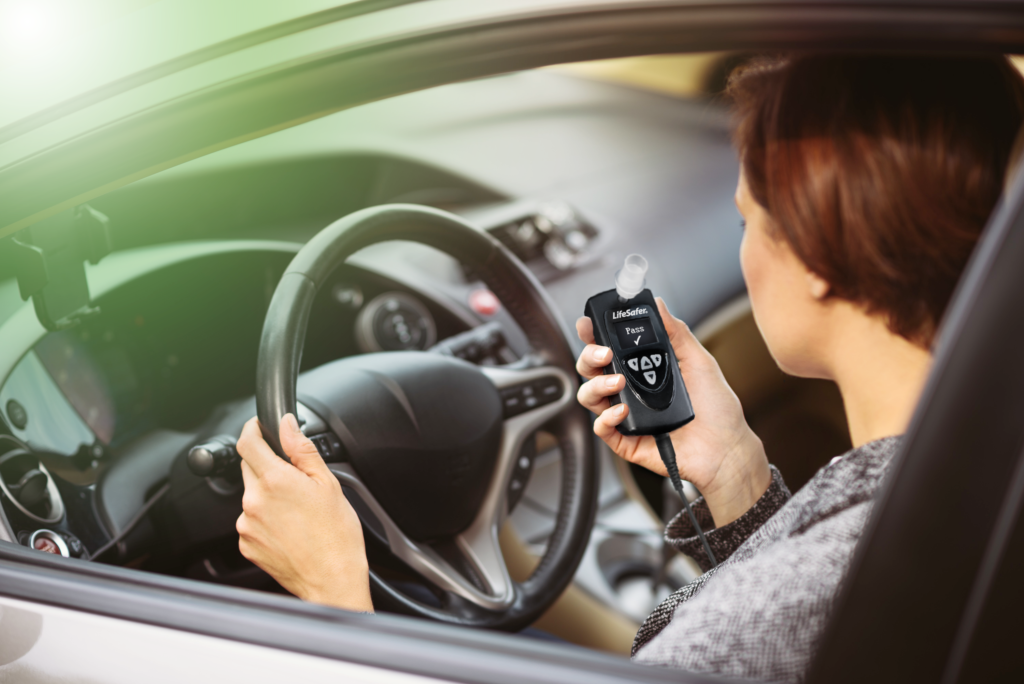
A breathalyzer measures the alcohol in that exhaled air to estimate your BrAC. An ignition interlock uses the same basic principle, but it’s built for a very specific job: checking a driver’s breath before their vehicle can start.
LifeSafer’s IIDs use fuel cell technology that reacts specifically to ethanol (the actual alcohol in your drink). The breath sample reaches a sensor containing platinum electrodes.
Any alcohol reaching the sensor causes a chemical reaction that produces an electrical current. The device measures that current and uses it to determine the alcohol concentration in the sample.
Older devices used semiconductor sensors that could be affected by perfume, certain foods, and even some mouthwash. Fuel cells don’t make that mistake nearly as often, helping ensure IIDs deliver more accurate results.
What Factors Affect How Long a Breathalyzer Can Detect Alcohol?
There isn’t a universal answer because there isn’t a universal person.
The amount of time alcohol remains detectable depends on you and what happened before you ever picked up the breathalyzer. This helps explain why your buddy can put away the same six beers and blow clean an hour before you do.
- Number of drinks: The more alcohol entering your bloodstream, the longer your body needs to process it.
- Body weight and composition: Alcohol spreads through your body’s water, so less body water relative to size generally means a higher BrAC from the same drinks.
- Biological sex: Physiologically, females often reach a higher BrAC than males from the same number of drinks, due to differences in body water and enzyme activity.
- Metabolism: Genetics, liver health, and certain medications all speed up or slow down how quickly you eliminate alcohol.
- Food in your stomach: Eating doesn’t lower your total BrAC, but it can slow alcohol absorption, affecting how quickly BrAC rises.
- Hydration: Water won’t burn off alcohol any faster. It might make tomorrow’s headache less brutal, but it won’t move your BrAC.
- Drink strength: “One drink” isn’t always one standard drink. A generous pour, high-alcohol beer, or strong mixed drink may contain substantially more alcohol than you realize.
- Tolerance: Tolerance changes how impaired you feel, not how fast your liver clears alcohol. Feeling sharp and being sober are two different things, and that gap is exactly what breathalyzers catch.
Only time can lower your BrAC. Black coffee, a cold shower, mints — they just mask the effects and smells of alcohol, briefly.
Will a Breathalyzer Detect Alcohol from Last Night?
Yes, and this is the scenario that catches the most people off guard because “last night” doesn’t feel like it should still count in the morning.
Picture this: It’s a friend’s birthday, you stop drinking at midnight, putting you at around 0.15% BrAC. At roughly 0.015% an hour, you’re not back to zero until close to 10 a.m. If you’ve got to make that 7 a.m. soccer game, you could still be legally over the limit, testing positive on an IID.
None of this is about outsmarting a machine, but a few helpful habits can help:
- Plan your drinking around tomorrow’s schedule: If you know you’re driving at 7 a.m., that’s the number to count backward from, not “whenever I feel done.”
- Rinse your mouth with water a few minutes before you test: “Mouth alcohol” — the residue left behind by a recent drink, mouthwash, or even some cough syrups — can register on the sensor even after your real BrAC has dropped, simply because the device is sampling what’s right at your lips.
- Never try to trick an IID: Don’t ask someone else to blow for you, try gadgets, or any type of workaround AT ALL. Beyond being against the rules, it’s exactly the kind of thing that leads to a failed test and real setbacks in your program.
Preplan and own your timing so nothing catches you off guard.
Stay on the Road with LifeSafer
Having an IID can change some routines, and you have to think ahead. A night out can’t end with “I’ll probably be fine by morning.” If you know you’ll need to drive early, make arrangements that don’t depend on guessing when your BrAC will hit zero.
Knowing your own detection window helps keep life predictable, keeps you driving, and means you have control over your social life.
An IID doesn’t mean the end of your social life. It’s the thing that lets you keep your license and your routine while you handle your program.
You can still go to the wedding, grab drinks after work, and show up for the people in your life. You just can’t drive after drinking.
LifeSafer offers the smallest IID on the market with transparent pricing and 35+ years of experience building and refining fuel cell technology.
Get started online, and we’ll walk you through exactly what happens next — no pressure, just answers.
Frequently Asked Questions
How long does it take for alcohol to not show up on a breath test?
Usually 12–24 hours after your last drink, though a single light drink can clear in one to two hours. The real number depends on how high your BrAC actually climbed. The more you drank, the more that upper end of the range applies to you.
How many beers is a 0.08 alcohol level?
For a lot of adults, three to four standard 12-oz beers can push you to or past 0.08%, but body weight, sex, and how fast you drank them all shift that number in either direction. Treating any fixed “beer count” as a safe rule is where people get into trouble.
How long does it take to be 0.00 after one drink?
A single standard drink may take roughly one to two hours to clear, but that’s only an estimate. A drink with more alcohol than a standard serving can take longer, and individual alcohol elimination rates vary. Don’t treat a one-drink estimate as a guarantee that you’ll pass your IID.
Does drinking water reduce alcohol breath?
No. Your liver processes alcohol at its own pace, no matter how much water you drink alongside it. Rinsing your mouth right before a test can help with residual mouth alcohol, but it won’t affect your actual BrAC.
Is four hours enough to pass a breathalyzer?
Sometimes, but it’s a gamble that depends entirely on how much alcohol you had. Four hours might clear one or two drinks, but if your night pushed toward 0.10% or higher, there’s a real chance you’re still testing positive.
This blog is for general informational and educational purposes only and does not constitute legal, safety, or other professional advice. Content may not reflect the most current legal, regulatory, or technological developments. Any examples, comparisons, or cost references are intended to provide general awareness only. To the fullest extent permitted by law, LifeSafer disclaims all liability for any action taken or not taken in reliance on this content. Please consult a qualified legal or safety professional for advice specific to your situation.